SLC Shrink Wrap Bundler with Cardboard Pad Inserter
The SLC is a medium-speed welding-bar shrink wrap bundler with a cardboard pad inserter. Bottles, jars, or cans are collated directly onto a corrugated pad, then sleeved. You get more pallet strength and fork-truck abuse resistance than film-only wrap, at a fraction of the board of a corrugated tray.
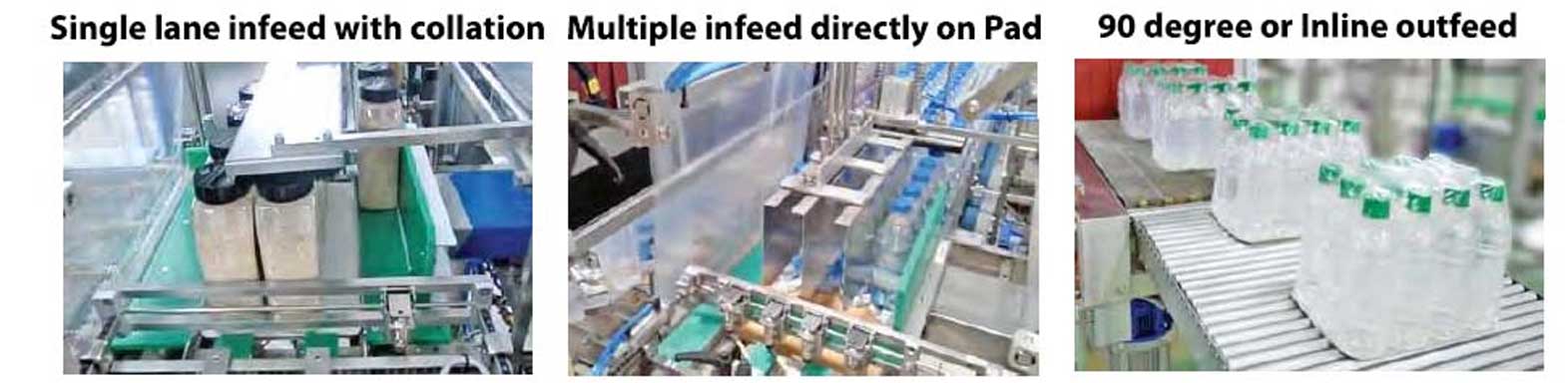
Side infeed: single-lane with horizontal collation onto the pad, or multilane loading straight onto the pad. Up to 14 packs per minute (typical 8–14 ppm on the M25 frame; taller H35 packs run about 5–10 ppm). If a given SKU does not need a pad, the same machine can run as a film-only bundler.
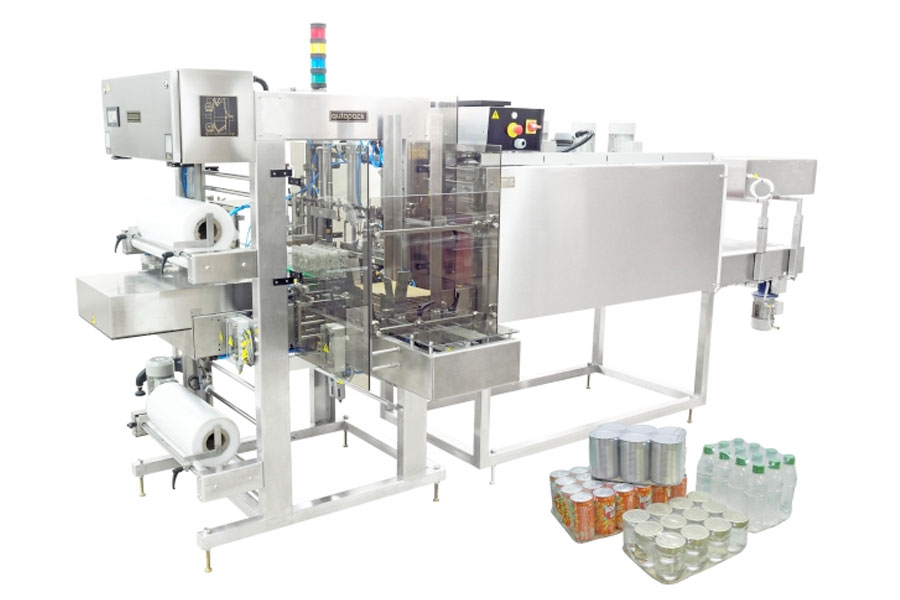
How the SLC builds a pad pack
- Pad magazine. A corrugated pad is fed from the magazine into the collation area.
- Side infeed. Single-lane product is grouped on the pad, or multilane infeed drops containers straight onto the pad.
- Welding bar. Two film rolls form a curtain. The pusher sends pad + product through; the bar seals top and bottom and remakes the curtain.
- Shrink tunnel. Heat tightens the sleeve around product and pad so the board becomes the pack base.
- Discharge. 90° or inline outfeed to the palletizer.
The tray is not erected. The pad is the base. That is the cost difference vs. SIT + tray packer.
Why plants choose the SLC
Pallet strength without tray cost. Autopack’s line: extra handling strength “for a minimum cost of cardboard.”
Collation happens on the pad. No separate pad placer upstream.
Single-lane or multilane. Slow/complex SKUs on one lane; faster lines load several lanes onto the pad.
Film-only when the pad is wasted. Same wrapper, pad magazine off.
Compact welding-bar line. Stainless, quick changeover, Allen-Bradley PLC/HMI on Holland-supplied systems.
At a glance
- Welding-bar shrink bundler with cardboard pad inserter
- Product collated directly onto the pad
- Single-lane horizontal collation or multilane onto the pad
- Up to 14 packs per minute (about 8–14 ppm M25; 5–10 ppm H35)
- Two film rolls, welding-bar sleeve
- Straight or 90° side infeed; 90° or inline outfeed
- Pad sizes typically 160–400 mm wide × 120–260 mm deep (brochure)
- Pack height to 200 or 350 mm depending on frame
- Can run without a pad (shrink-bundle mode)
- Stainless construction, compact footprint
- Custom infeed and discharge
Popular Options:
Optional. If every pack needs a pad, look at SLC first.
Same “many containers” problem. CMOS is overlap, one film roll, printed film, higher cycle rate. SLM is welding bar, two rolls, lower cost, still tandem-fast.
SIM is inline, one grouping path. SLM is side infeed, multi-lane, with optional diverter and tandem out — built when container rate outruns a simple SIM.
Single-track 45/60: about 12–28 packs/min. Tandem 62/82: about 35–50 packs/min. Do not quote 55 ppm unless the application is a twin-track frame.
It splits oblong, rectangular, or square bottles into multiple lanes (Autopack: up to five). Line speed can approach ~300 bottles per minute. That is bottles, not packs.
Bottles, cans, and cartons that can accumulate and lane. Beverage and grocery are the usual fit. Oval bottles that must rotate belong on SLO; tippy bottles on SLR.
Twin-track: the wrapper makes two packs per cycle and both go through the tunnel. That is how 62SLM/82SLM reach ~35–50 packs/min.
Optional. This is a welding-bar machine. For registered print plus a pad at higher speed, ask about SIC CMOS.
Both. Single-lane collates onto the pad. Multilane loads containers directly onto the pad for faster lines.
No. If a pad is not needed, the machine runs in shrink-bundle mode.
Up to 14 packs per minute. Brochure: about 8–14 ppm on 60SLCM25, 5–10 ppm on the taller 60SLCH35. Multilane infeed raises container rate into the pad, not always packs/min.
Film-only is cheaper. Add a pad when packs crush, slide, or fail in the warehouse without a base.
A pad is less corrugated than a formed tray, but it still gives a flat base for palletizing and handling. Use a tray (SIT) when you need walls or a tray packer you already own.
It inserts a corrugated pad, collates bottles, jars, or cans onto that pad, and shrink-wraps the pack with a welding bar — pad-and-film in one machine.